
Three things to do right now
Once a spring breaks, the door’s weight lands on whatever is holding it: the opener, the cables, or someone’s hands. None of them is meant to carry it. Three steps keep things safe until the repair.
- Stop using the opener. Unplug it if you can reach the cord without standing under the door. The motor isn’t built to lift the door without the spring, and trying strains the gear and can pull the door crooked.
- Leave the door where it is. Closed is the safest place for it. If it is stuck open or partway up, keep people, pets and cars out from under it.
- Call us. Say if the door is up or down, if a car is parked inside, and how many springs you can see above the door.
That is all we ask of you. The rest takes proper winding tools and springs matched to your door.
Signs your garage door spring broke
Many people hear it happen: a loud bang from the garage, often when nobody is near the door. A spring under tension snaps at a weak point and the coils unwind in an instant.
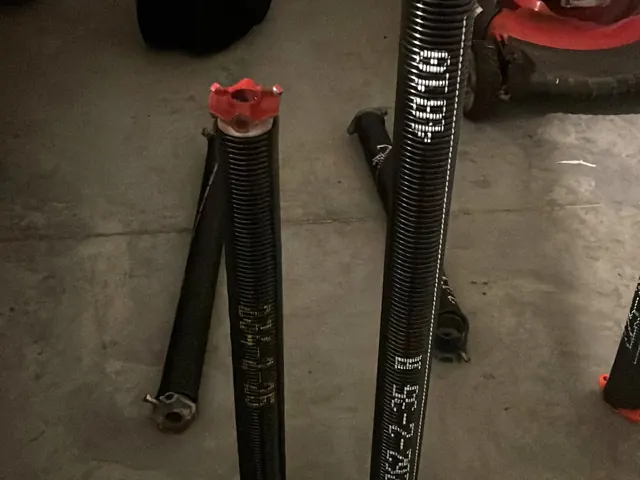
Then look. A torsion spring is mounted on the steel shaft over the door; when it snaps, a gap of a few inches splits the coil in two. Extension springs run above the horizontal tracks on each side. A broken one hangs loose on the safety cable through its middle, or lies on the floor if the door has no safety cable.
The door gives it away too: the opener hums and gives up after a few inches, or one side lags and the door rises crooked. On a two-spring door, one broken spring may still let the door move, but slowly and with obvious strain.
Can you open a garage door with a broken spring?
Not safely, and we’d ask you not to try. The springs are what make a garage door feel light. Their tension offsets the door’s weight, so a working door lifts with one hand and stays put halfway. With a broken spring, that weight is all back.
The opener can’t take over the spring’s job. It is built to move a balanced door, not to hoist a dead weight, and forcing it can strip the gear, bend the rail or snap a cable. Lifting by hand is worse: the door can come down hard if a hand slips, and anything used to prop it can give way.
Leave the other parts alone too. The surviving spring, the cables and the bottom brackets (the anchors at each bottom corner of the door that hold the cable ends) are still under tension. Loosening or adjusting any of them is how people get badly hurt.
Why springs wear out
Springs are a wear part. Every trip up and down flexes the steel, and after enough cycles it cracks. Many standard springs carry a rating of roughly 10,000 cycles, and one cycle is the door going up once and coming back down. Near the end of its life, a spring can make the door feel heavier or the opener strain before it finally snaps.
A door that runs several times a day uses up those cycles sooner than one opened once a day. Near the bay or the ocean, rust also shows up sooner on metal parts, springs included; our page on salt air and garage doors covers that.
When a car is stuck in the garage
A car trapped behind a dead door is often what makes a broken spring urgent. Mention it when you call. A spring repair usually takes a single visit, and same-day service is available for many spring calls.
If you must leave before we can come, take a ride or a second car rather than forcing the door. When it can’t wait, our emergency garage door repair page explains how urgent calls work. We pick up 24/7, late calls included.
How we repair a broken spring
We start with the whole door, since a spring that broke may have knocked a cable off its drum or strained the opener. Then we fit springs matched to your door’s size and weight, set them to the right tension, and balance the door so it holds halfway by hand.
On a door with two springs, we usually suggest doing both. They went up together and have worked the same number of cycles, so the second is often not far behind. You hear the price of each option first and decide. You pay nothing for the estimate itself. A 1-year labor warranty comes with the repair.
Before we leave, we test the balance, the sensors and the auto-reverse. Our spring repair page has more detail, and you can book from the booking page. We repair springs across Miami-Dade and Broward, including Miami Gardens, Coral Gables and Miramar.