
Why the garage door matters in hurricane season
FEMA’s guidance on wall openings spells out how that opening fails. In high winds a garage door can be pushed in, pulled out or twisted off its tracks. Once it gives way, wind and rain are inside the garage with nothing to stop them.
In the Florida Building Code’s terms, Miami-Dade and Broward both sit in the HVHZ (High-Velocity Hurricane Zone). Garage doors approved for homes here carry either a Notice of Acceptance (NOA) from Miami-Dade or a Florida product approval. Each NOA spells out the design pressures, meaning the wind loads the product was approved to resist, and it carries an expiration date.
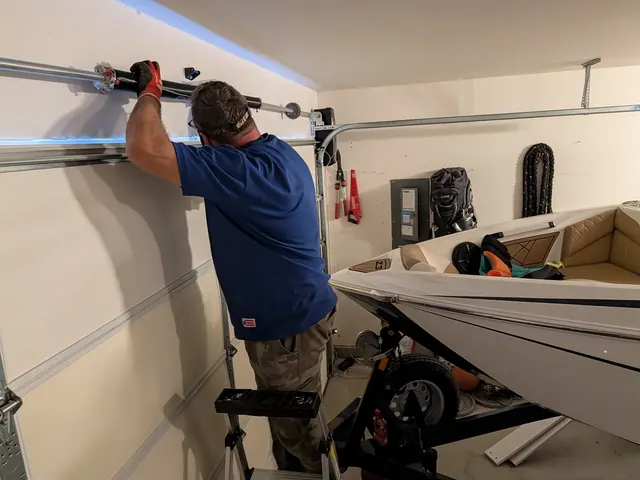
Even an approved door depends on its parts. Loose hinges, rusted bolts and worn rollers all leave it less able to stay in its tracks under load. Finding those before the first storm is the point of a pre-season check.
The homeowner’s checklist: look and listen
Pick a dry day in May or early June. You need no tools, and the springs, cables and bottom brackets stay off limits: look at them, don’t touch them.
- Run the door once and listen. Grinding, scraping or squealing points to worn rollers or dry hinges. A bang or a sudden lurch can mean a spring problem.
- Watch how it moves. It should travel smoothly and evenly, without jerking or one side lagging behind.
- Look at the springs. A gap in the coil above the door, or a stretched spring along the tracks, needs repair before a storm.
- Look at the cables. Frayed strands or rust near the bottom corners are a warning sign.
- Check the tracks and rollers. Bends, loose brackets and rollers that wobble or ride outside the track weaken the door’s hold in its tracks.
- Look for rust and loose bolts. Hinges, bolts and brackets on the inside face of the door are easy to miss until a storm finds them.
- Test the auto-reverse. Lay a piece of two-by-four flat in the doorway and close the door. It should reverse when it touches the board. Keep hands and feet clear.
- Check the bottom seal. Daylight under the closed door or a torn seal lets wind-driven rain in.
- Find the release cord, the backup battery and the paperwork. The red cord should hang where an adult can reach it, and a battery backup shouldn’t be beeping. If you have the door’s papers, note its NOA or Florida approval number.
Keep a photo of that approval number with your insurance documents, and tell us about anything odd when you call.
What we check before the season
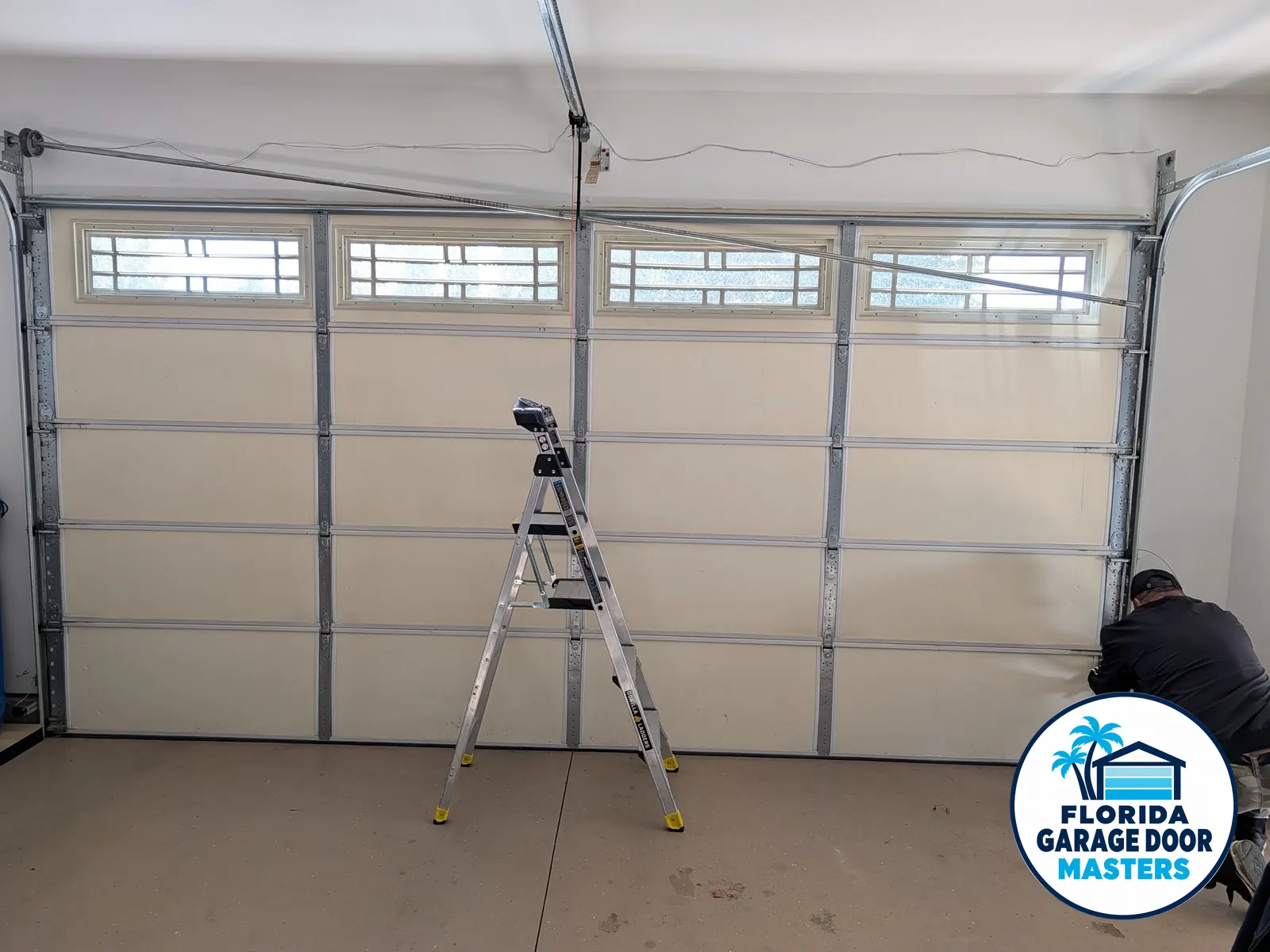
A pre-season visit is a closer version of that list, plus the parts you shouldn’t handle. We check spring tension and door balance, the cables and drums, the bottom brackets, the rollers and hinges, the tracks and their brackets, and any struts already on the door. Loose hardware gets tightened and moving metal parts get lubricated.
Then the opener: the sensors, the auto-reverse, the force setting, the release and the battery backup. We repair worn parts with matching ones, so the door stays as it was built. You hear the price first, and nothing is done without your yes. The estimate itself is free.
Our hurricane prep and storm repair page covers this visit and the repairs we do after a storm. If the door only needs routine care, a tune-up covers lubrication, the balance test and the safety checks. We do both across Miami-Dade and Broward.
When a storm is coming, and after it passes
As a storm comes closer:
- Close the door all the way and leave it closed. A door left partly open gives the wind a handle.
- Move cars, bikes and loose items away from the inside of the door.
- Unplug the opener if water could reach it.
Once the wind has dropped, look before you press the button. Don’t force a door that is bent, off its track or hanging crooked, because the springs and cables are still under tension. Photograph any damage for your insurance claim, then call us.
Ask your insurance agent about a wind mitigation inspection, which documents protected openings such as a rated garage door; many Florida insurers give credits for them. The state’s My Safe Florida Home program has also offered inspections and grants to qualifying homeowners, so check its official site for what is available.
Homes near the water
FEMA’s guidance notes that salt spray corrodes metal connectors. For buildings roughly 3,000 feet or less from the shore, it recommends fasteners made of stainless steel or hot-dipped galvanized steel. If your home is close to the ocean or the bay, as many are in Miami Beach and parts of North Miami Beach, rust deserves extra attention.
On a coastal door we look closely at hinges, fasteners, cable ends and bottom brackets, where rust tends to start. Our salt air care guide has more.
HOA rules, and a door that’s past repair
If a homeowners’ association governs your street, check its rules before any change to how the door looks from outside. State law, section 720.3035(6) of the Florida Statutes, treats reinforced garage doors as a form of hurricane protection. If an owner’s application follows the specifications the association has adopted, the HOA can’t turn it down, though it may still require you to follow an existing unified building scheme for the outside look. That law covers homeowners’ associations, not condos. Our page on HOA garage door rules explains more.
Now and then a door is too damaged or too worn to be worth fixing. Then we can install a new one, an impact-rated door included. The new door needs an NOA or a Florida product approval, and a permit from the city or, outside city limits, from Miami-Dade County; we help with that paperwork.
When fixing a door no longer makes sense, we tell you plainly, and the choice is yours. A pre-season visit can be set up by phone at (786) 349-6912, or through the booking page.